
If you've wanted to play heavier rock, punk, grunge or metal guitar, power chords are a great place to start. Unlike many full chords, you can play a power chord with just two notes.
That simple shape makes power chords useful for energetic rhythm guitar—especially with distortion—and for writing your first original rock riffs.
What is a power chord?
A basic power chord contains a root note and its perfect fifth. It doesn't contain the third that normally determines whether a chord is major or minor.
Power chords are written with the number 5: E5, A5, G5, D5 and so on. You can play them with two notes or add an octave of the root for a fuller sound.
Three easy open-string power chords
| Power chord | Two-note shape | Strings to play |
|---|---|---|
| E5 | 02xxxx |
Low E and A |
| A5 | x02xxx |
A and D |
| D5 | xx02xx |
D and G |
The shapes are read from low E to high E. 0 means an open string; the number means a fret; x means don't play that string.
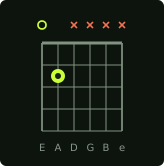
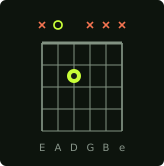
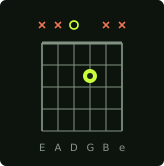
Start with E5: play the open low E string and second fret of the A string together. Then move to A5 and D5.
These three shapes let you practise changing chords without moving far up the neck.
How to move power chords around the neck
Place your index finger on the third fret of the low E string and your ring finger on the fifth fret of the A string. That's G5.
Move the same shape two frets higher and you have A5, using frets five and seven. The shape stays the same; the chord changes according to where you put it.
That's one reason power chords are so useful for writing rock music.
Your first power-chord riff
Try this original progression:
E5 – E5 – G5 – A5
Play each chord once on a steady beat and repeat the pattern four times. Then play E5 twice quickly, pause briefly, and let G5 and A5 ring.
Notice how changing the rhythm can make a simple progression much more energetic.
Add palm muting
For a tighter sound, rest the side of your picking hand gently against the strings near the bridge. The aim is to shorten the ring without silencing the notes completely.
Mute the first two E5 chords and let G5 and A5 ring. Contrast makes movement without extra notes.
Common mistakes to avoid
- Don't squeeze the neck harder than needed for a clear note.
- Mute unused strings so they don't ring accidentally.
- Move both fingers together when shifting a movable shape.
- Prioritize steady rhythm over speed.
A simple, well-timed power-chord riff can be more effective than a complicated phrase played unevenly.
Write your own power-chord riff
Choose three power chords. Put them in a different order. Add a pause or repeat one chord. Record the arrangement that feels best.
Riff Roulette helps turn little experiments like these into original musical ideas with creative challenges, drum grooves and riff recording.