
Learning guitar chords is one of the fastest ways to go from playing individual notes to making actual music. You don't need dozens of complicated shapes, expensive equipment, or years of lessons to get started.
In fact, eight fundamental chords give you a foundation for playing a huge variety of songs, developing your rhythm, and eventually writing music of your own. Let's start with the shapes that matter most.
How to read guitar chord shapes
A chord is a group of notes played together. On guitar, you create chords by pressing certain strings against the frets while strumming or picking.
The shapes below use six-character notation. Read each shape from the thickest string (low E) to the thinnest string (high E).
- 0 means play that string open, without pressing a fret.
- 1, 2, 3, etc. mean which fret to press.
- x means avoid playing that string.
For example, 022000 is an E minor chord: play the low E open, fret the A and D strings at the second fret, and let the remaining three strings ring open.
The eight essential beginner guitar chords
| Chord | Shape (low E → high E) | Why learn it |
|---|---|---|
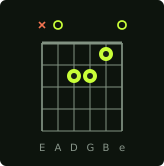
| E minor (Em) | 022000 |
Two fingers, rich sound, an easy starting point |
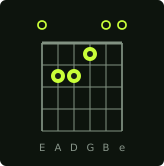
| G major (G) | 320003 |
A foundation for countless progressions |
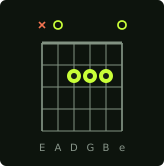
| C major (C) | x32010 |
Builds finger independence |
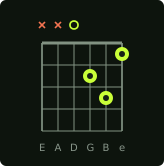
| D major (D) | xx0232 |
Helps you focus on the higher strings |
| A minor (Am) | x02210 |
Adds a minor-chord sound |
| E major (E) | 022100 |
Classic rock and blues foundation |
| A major (A) | x02220 |
Useful in rock, country and blues |
| D minor (Dm) | xx0231 |
Introduces another minor chord shape |
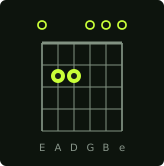
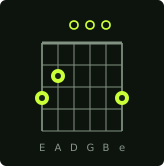
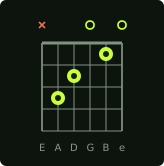
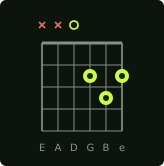
Start with E minor
Place your middle finger on the second fret of the A string and your ring finger on the second fret of the D string. Strum all six strings slowly. Each note should ring clearly.
If a string sounds muted, move your fingertips closer to the fret without resting directly on the metal fretwire. Keep your wrist and hand relaxed.
Add G, C and D
Once E minor feels comfortable, introduce G, C and D major. Don't rush: learning to change chords smoothly is more useful than memorizing ten shapes you can't yet move between.
Practise changing between two chords without stopping, even if you initially need a few seconds to reposition your fingers.
Your first four-chord progression
Try this progression:
Em → C → G → D
Play four gentle downstrokes on each chord. Repeat the sequence four times. Your goal isn't speed; it's a steady sound and less hesitation between changes.
After a few repetitions, experiment with your strumming rhythm. Try two strums per chord, or let one chord ring longer. You're already making musical choices.
A five-minute beginner chord workout
- Minute 1: Play E minor cleanly, checking that every intended string rings.
- Minutes 2–3: Change between Em and C without stopping.
- Minute 4: Switch between G and D.
- Minute 5: Play the full Em–C–G–D progression.
If you make a mistake, keep the pulse going and try again on the next chord. Consistency matters more than perfection.
What should you learn after basic guitar chords?
The next step isn't necessarily another 20 chords. Start discovering what you can do with the ones you know: change their rhythm, pick individual notes, or combine them into a short melody.
That is how an ordinary chord progression can become the beginning of an original riff. For an easy next step, try our guide to turning chords into riffs.
From learning chords to creating music
Once you can play a few chords, try writing something of your own. Riff Roulette gives guitarists creative challenges, drum grooves to jam with and a way to record and save their own ideas.
You don't need to be an expert. You just need a starting point and a willingness to experiment.